No sales pressure, just the facts and our honest take — we put this guide together so you can make a smart, informed choice on your build.
Color Changes Everything
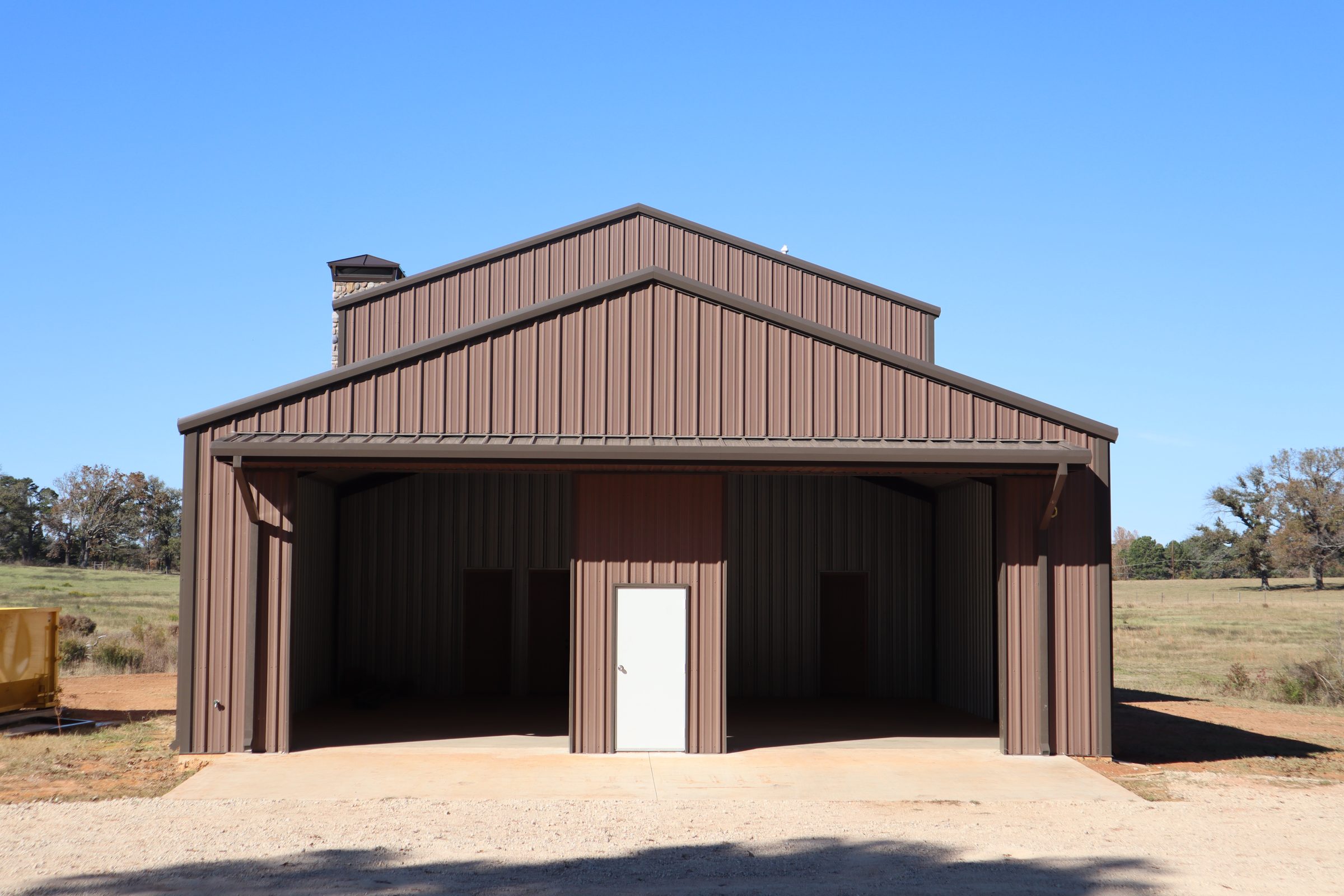
Under the Texas sun, two identical buildings with different roof colors can have surface temperatures that differ by 50°F to 80°F. Lighter colors bounce the sun's energy away. Darker colors soak it up and drive that heat down into your building. On a hot summer afternoon, here's what those panels are running:
| Panel Color | Surface Temperature | What It Means |
|---|---|---|
| White / Light Gray | 110°F – 120°F | Reflects up to 90% of sunlight |
| Medium Brown / Gray | 150°F – 160°F | Noticeably more heat soaked up |
| Black / Dark Charcoal | 170°F – 180°F | Hottest surface, most heat gain |
Bottom line on the numbers: a reflective, light-colored metal roof can cut your summer cooling costs by roughly 7% to 15% during the hottest months. But here's the part most folks don't know — thanks to modern coatings, dark doesn't have to mean hot anymore.
The “Cool Roof” Breakthrough
To understand how a dark roof can stay cool, you've got to know what's actually in sunlight. It comes in three parts:
- Ultraviolet (UV) — about 5%. Fades color and breaks down paint over time.
- Visible Light — about 43%. The part your eyes see. This is what gives a panel its color.
- Near-Infrared (NIR) — about 52%. Completely invisible to you — but it carries over half of the sun's heat.
Cheap dark paint uses “carbon black” pigment, which acts like a sponge — it swallows both the visible light and the invisible heat. Modern “cool” coatings pull off a clever trick instead, using infrared (IR) reflective pigments: for your eyes, the pigment absorbs visible light, so the panel looks rich and dark; for the sun, that same pigment acts like a mirror to the invisible infrared heat, bouncing it right back into the sky. It's a two-layer defense — the color coat shows the dark color while reflecting heat away, and a reflective primer coat underneath catches any heat that slips through and sends it back out before it ever reaches the raw steel.
The payoff: a dark roof built with cool pigments can run 30°F to 40°F cooler than the very same color in a standard coating.
We'll always shoot you straight — a dark roof will never be quite as cool as a pure white one. But these coatings close the gap so much that color is now a style choice, not a comfort sacrifice. Pick the look you love.
Your Two Coating Options
When we spec your panels, you'll typically choose between two factory-baked finishes. Both carry the same strong factory warranty — a 30-year colorfastness warranty and a 40-year film integrity warranty — but they perform very differently over the long haul.
Signature 200 — SMP (Silicone Modified Polyester)
High-gloss and shiny when new, with excellent scratch and impact resistance that shrugs off shipping, install, hail, and tree limbs. It's the economical baseline. The catch: over 15–20 years, UV breaks the polyester down faster — it fades and “chalks” (a powdery residue), losing some cool-roof reflectivity as it does. Best for white and light colors, and budget-minded builds.
Signature 300 — PVDF (70% Kynar®, Low Gloss)
A low-gloss matte finish with a modern, high-end architectural look and no blinding glare. The paint is slightly softer — we handle it with extra care on install — but chemically it's near-bulletproof, practically immune to UV, acid rain, and humidity. At a 15% to 30% premium over the Signature 200, it locks cool pigments in place for 30 to 40+ years with virtually no fade. Best for medium-to-dark colors, and anyone who wants the longest-lasting color and performance.
| Feature | Signature 200 (SMP) | Signature 300 (PVDF) |
|---|---|---|
| Resin Type | Silicone Modified Polyester | 70% Fluoropolymer (Kynar) |
| Visual Sheen | High gloss (shiny) | Low gloss (matte / flat) |
| Scratch Resistance | Excellent (harder) | Good (softer) |
| Fade & Chalk Resistance | Moderate — fades over time | Superior — immune to UV aging |
| Long-Term Heat Performance | Drops as paint chalks | Stays reflective for decades |
| Relative Cost | Baseline / economical | 15% – 30% premium |
One thing worth knowing: even though both carry the same warranty length, the allowable fade on the Signature 300 is much tighter. Pick a bold or dark color — red, green, bronze, charcoal — and the 200 will visibly shift over 20 years, while the 300 looks nearly identical to install day.
What About Bare Galvalume?
A lot of folks assume shiny silver Galvalume beats every dark roof, because it looks reflective. Not so fast — there's a second half to this equation most people never hear about. Staying cool takes two things: solar reflectance (bouncing heat away in the first place) and thermal emittance (releasing the heat the panel does absorb, instead of holding it).
Bare Galvalume nails the first one when new, reflecting 65–70% of sunlight, but fails badly on the second. Its emittance is very low (around 0.10–0.25), so once it absorbs heat, it holds it like a sponge and radiates it straight down into your attic and building. The painted Signature finishes have high emittance (0.85+) — they dump trapped heat right back into the sky. And bare Galvalume oxidizes: within a few years it dulls to a gray patina and permanently loses reflectivity, running hotter than it did on day one. A dark Signature 300 panel won't dull at all.
| Feature | Bare Galvalume | Sig 200 (Dark) | Sig 300 (Dark) |
|---|---|---|---|
| Initial Heat Bouncing | Excellent | Good | Good |
| Heat Dissipation | Poor — holds heat | Excellent | Excellent |
| Aging Effect | Oxidizes to dull gray | Slowly chalks | Stays stable |
| Reflectivity Over Time | Drops sharply | Drops as it fades | Stays flat for decades |
The takeaway: don't let a dark color scare you off. A dark panel in Signature 300 low-gloss PVDF will match or beat an aged bare Galvalume roof in energy efficiency over the life of the building — and look a whole lot sharper doing it.
The Bee Happy Bottom Line
- Going light or white? Signature 200 is a smart, money-saving choice — the heat difference up top is minimal.
- Going dark, or want it looking new in 30 years? Signature 300 PVDF is worth every penny. It keeps a dark roof cool and crisp for decades.
- Don't fear the dark colors. With the right coating, you get the look you want without cooking the building.
And remember — the roof is only part of the story. Good ventilation and quality insulation move a ton of heat out before it ever reaches your living space. We build that in from the start, so your whole system works together.